

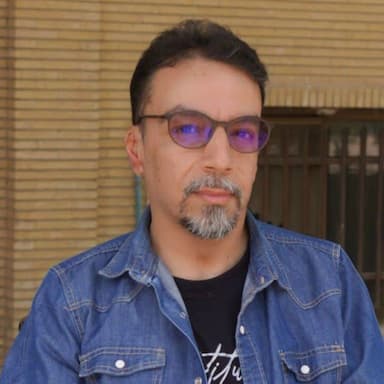
Roohollah Datli Beigi, Ph.D. ,
Assistant Professor
Department Of English Language And LiteratureFaculty Of Foreign Languages
Address
University of Isfahan
Azadi square
Isfahan, Iran
Postal Code : 8174673441
Biography
Dr. Roohollah Datli Beigi received his B.A. degree in English Literature from University of Isfahan in 2009, and an MA degree in the same field from University of Isfahan in 2012. He received his PhD degree in English Literature from University of Isfahan in 2021. He joined University of Isfahan as a part-time lecturer in 2017, and is now an assistant professor of English Literature at the English department.
Research Interests
His research interests include Romantic literature, teratological studies, and literary theory.
Professional activities
Teratological studies as follows; 1. Exploration of Shakespearean plays, Romantic literature, American 19th-century romance, and Modern and postmodern literature through the lens of Disability Studies and Teratological Studies as follows: • Reading cross-dressing, transgressive speech, human/inhuman boundaries, and the monstrous Other (e.g. monstrous mothers, witch or Gorgon, deformed characters, and colored characters) in Shakespeare plays through postcolonial/gender monstrosity frameworks • Examining Romantic monstrosity―such as sublime dread, monstrous beauty, the monstrous outsider, hybridity (animal/human blends, metamorphosis, hermaphroditic or androgynous forms), and deformed landscape/nature―in Romantic poetry and prose • Using race and monstrosity frameworks (1) to read how racialized bodies are rendered monstrous in American 19th-century slavery narratives, romances, and Gothic tales; and (2) to examine the monstrous as political allegory, in which national anxieties are depicted as deformed, exotic, and uncanny bodies in the works of writers such as James Fenimore Cooper, Washington Irving, Robert M. Bird, Edgar Allan Poe, Nathaniel Hawthorne, Herman Melville, etc. • Reading modernist experiments with fragmentation, ventriloquism, and stream of consciousness as forms of deformed and monstrous speech, resulting in psychic monsters and internalized anxieties in writers and poets such as James Joyce, Virginia Woolf, T. S. Eliot, etc. • Treating monsters as devices that destabilize grand narratives in postmodern literature, as the monstrous interrupts stable identity, authorship, and genre (metafictional monsters); by framing metafictional intrusions that renders the text itself as monstrous (text-as-body, narrative as hybrid); and by depicting paranoia and psychopath as the manifestations of invisible and ubiquitous monstrosity in postmodern fiction • Postcolonial monsters and monstrosity as manifestations of defiance against the dominant (white) discourse • Posthuman Teratology/monstrosity (the inhuman, the a-human, the non-human) in modern and postmodern literature 2. Interdisciplinary reading of Romantic poetry and literature, as well as modern and postmodern literature, through ecocriticism and Anthropocene studies integrated with teratological studies and monstrosity; the following examples can be illustrative: - Toxic creatures, hybrid species, mutations, aberrant forms, and invasive growths of various organisms (e.g. in P. B. Shelley’s The Sensitive Plant) as manifestations of monstrosity that generate environmental anxieties - Mary Shelley's Frankenstein as an example in which Anthropocene and Teratology converge, with Victor Frankenstein serving as a geological force who alters species, resulting in the creation of a hybrid creature/monster born from human technological overreach 3. Probing the above-mentioned literary periods through the lenses of Lacanian Psychoanalysis, Archetypal Criticism, Affect Studies, Schema Theories, and other related approaches Question: Why do any of the above-mentioned study areas matter now? How these ideas can be used by contemporary human societies? Answer: Monsters and monstrous forms serve as mirrors of contemporary fears and anxieties, as the human societies may externalize these anxieties into monstrous forms, such as viral outbreaks, AI, surveillance states, and ecological disasters. Monsters in contemporary societies are cultural projections that reveal collective psychology. The study of monstrosity and teratology across literary history, especially when combined with Anthropocene and ecocritical perspectives, can provide modern human societies with tools and equipment to understand how contemporary fears/anxieties, identities, and ecological crises are culturally constructed. Analyzing how past cultures created monsters to manage anxieties about race, gender, nature, and knowledge, we can better recognize the technological, environmental, and political monsters of our own era and respond to them with more awareness, empathy, and new ethical frameworks.
Teaching
BA English literature courses MA English literature courses: 1. Shakespeare's Drama 2. Romantic Poets 3. Contemporary Poetry 4. 20th Century American Literature
Monstrous Alphabet in J. M. Coetzee’s Foe
( Article )
Speechless complainer: A Derridean reading of Titus Andronicus
( Article . Gold )